
Login

Blog

Discover what a graphic illustrator in branding & design really looks like with expert insights.

Day: May 10, 2026

watch Premier League IPTV UK
Uncategorized

How to Watch Premier League with IPTV in the UK (2026)

If you want to watch Premier League IPTV UK, you are not alone. Live football is one of the biggest reasons people search for IPTV in the first place. Fans want a setup that feels simple, flexible, and ready for match day without turning the whole process into a headache. At the same time, they want strong picture quality, easy access on different devices, and a viewing experience that fits modern habits. That is exactly why this topic matters. Traditional television setups can feel more rigid, while IPTV often feels more suited to the way people already watch content in 2026. Instead of being tied to one old viewing model, many users now want football access through Smart TVs, Firestick devices, Android boxes, and other streaming-friendly screens. Therefore, if your main goal is to follow league matches more conveniently, IPTV becomes an attractive option. If you are already comparing options, start with this Primestelly IPTV UK page. Also, if you need help setting everything up before the next match, read how to set up IPTV on Firestick in the UK and how to install IPTV on Smart TV in the UK. Why People Use IPTV for Premier League Football The biggest reason is convenience. Football fans do not just want channels. They want access that works across the devices they actually use. They want to switch on the TV, open the app, find the match, and start watching without a confusing process. Another major reason is flexibility. Some fans watch in the living room on the main TV. Others use a second screen in a bedroom, office, or another part of the home. Some prefer a streaming stick, while others use a Smart TV app. IPTV works well for this kind of viewing lifestyle because it feels more adaptable than old television setups. There is also the issue of value. Viewers now compare everything carefully. They do not only ask what content is available. They also ask whether the setup feels practical, whether the interface is easy to use, and whether the service fits into a more modern home entertainment setup. That is why interest in live football IPTV keeps growing. It is not only about the matches themselves. It is also about the overall experience around those matches. What You Need to Watch Premier League with IPTV in the UK If your goal is to watch Premier League IPTV UK properly, the setup is actually simple when you break it down into the basics. You need: That is it. Once those parts are in place, the experience becomes much easier. 1. A Stable Internet Connection Football is live content, so stability matters a lot. If your internet drops, becomes congested, or struggles during busy hours, the match experience can suffer. Because of that, your connection is one of the first things to check before blaming the app or the device. In general: So if your speed looks good on paper but your Wi-Fi is inconsistent, you may still face issues. 2. A Compatible Device Many people use one of these: For most UK users, Firestick and Smart TV are the easiest options. That is why those two setup articles are important in your content cluster. If you are not sure which route to take, the easiest starting point is usually how to set up IPTV on Firestick in the UK. 3. A Reliable IPTV Service The service you choose affects the whole football experience. Even the best device and app will not help much if the service itself feels unstable, slow, or messy. That is why many users focus on finding a service that feels smooth on match day, especially during high-traffic fixtures. If you are still comparing options, check this best IPTV UK page. 4. A Good IPTV Player App The app matters because it controls how easy it is to browse channels, open the guide, use favourites, and switch between live streams. If the player feels clumsy, the whole experience becomes more frustrating than it needs to be. For that reason, choosing the right player is part of the setup. You can compare your options in best IPTV apps for Firestick and Android in 2026. Why IPTV Fits Football Fans So Well Football viewing is different from casual entertainment. A fan does not want to waste time when the match is about to start. They want quick access, smooth loading, and a simple route from opening the app to seeing the game live. That is where IPTV often feels stronger for many users. It fits a world where people want: The experience can also feel more flexible around match days. Fans often want pre-match access, live action, and post-match viewing without changing systems or relying on a rigid old-style setup. Best Devices for Watching Live Football on IPTV Not every user watches in the same way, so the right device depends on your home and habits. Firestick Firestick is one of the most practical options because it is affordable, simple, and easy to move between screens. It also works well for users who want a clean streaming setup without needing a complicated installation. That is why it is such an important part of your cluster content. If this is your device, go straight to IPTV on Firestick UK. Smart TV A Smart TV setup is ideal for viewers who want fewer devices and a cleaner living room environment. You install a compatible app, enter your details, and watch directly from the television. This works well for football fans who want everything on the main screen without adding extra hardware. Android Box Android boxes are another strong option, especially for users who want a little more control or a dedicated streaming device. They can work very well for live football when paired with the right player. How to Set Up IPTV for Premier League Matches The setup itself is not complicated. In fact, once you understand the flow, it becomes very easy. Step 1: Choose Your Device
is IPTV legal UK
Uncategorized

Is IPTV Legal in the UK? Everything You Need to Know

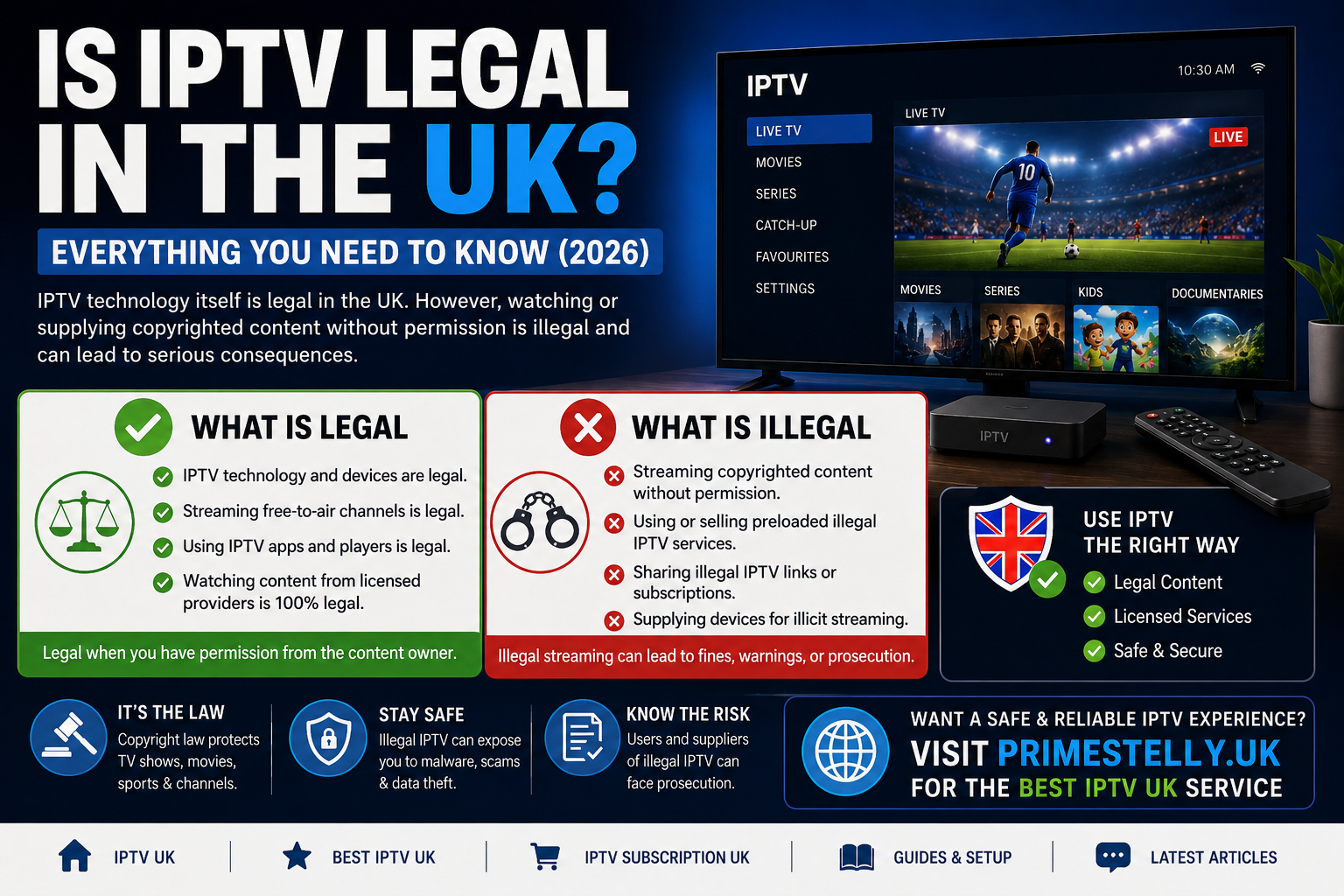
If you are asking is IPTV legal UK, the most accurate answer is this: IPTV technology itself is legal, but watching or supplying copyrighted content without the right holder’s permission is not. UK government guidance says illicit streaming means watching content without the copyright owner’s permission, and it adds that streaming devices are legal when used for legitimate, free-to-air content but become illegal when adapted to stream illicit content. (GOV.UK) That distinction matters because a lot of confusion comes from people using the word IPTV to describe both a technology and a business model. The technology is simply internet-delivered television. In the UK, internet TV and on-demand TV are widely recognised and regulated parts of the media landscape, including under the Media Act changes being implemented by Ofcom and the government in 2026. (www.ofcom.org.uk) So, if you are researching IPTV UK options, it is important to separate lawful internet TV delivery from unauthorised access to protected content. That is the key legal line in the UK. If you also want the beginner setup side, read what is IPTV and how does it work in the UK and how to set up IPTV on Firestick in the UK. (GOV.UK) What Makes IPTV Legal or Illegal? The main issue is permission. UK IPO guidance says copyright is usually infringed when someone carries out restricted acts without the rights holder’s permission. In plain language, if a service has the right to distribute the content, that use can be lawful. If it does not, the streaming can cross into infringement. (GOV.UK) That is why the legal question is not “Is IPTV legal?” in the abstract. The better question is: Does the service have the rights or permission to provide the content being streamed? If the answer is yes, the setup can be lawful. If the answer is no, the legal risk changes completely. (GOV.UK) IPTV Technology Is Legal This part is important to say clearly. IPTV as a delivery method is not banned in the UK. The government and Ofcom both regulate large parts of today’s internet TV and on-demand environment, which only makes sense because internet-delivered TV is itself a legitimate part of the modern media system. Recent 2026 government and Ofcom updates on video-on-demand rules and Media Act implementation show that regulated internet TV services are part of normal UK broadcasting and on-demand policy. (GOV.UK) So when people say “IPTV is illegal,” that is too broad to be correct. The more precise statement is that unauthorised streaming of copyrighted content is illegal, while lawful internet-delivered television services are part of the normal UK market. (GOV.UK) When Does IPTV Become Illegal in the UK? UK government guidance is quite direct here. It says devices are legal when used for legitimate, free-to-air content, and they become illegal once adapted to stream illicit content such as subscription channels, films, or TV programmes without paying the appropriate subscriptions. The same guidance also says illicit streaming is watching content without the copyright owner’s permission by any means, not just through hardware devices. (GOV.UK) That means the legal problem is not only about a box or stick. It can also involve apps, accounts, playlists, or services that give access to protected content without authorisation. So the key issue is not the device itself. It is the use and the rights behind the content. (GOV.UK) Is Watching Unauthorised IPTV a Risk for Viewers? Yes, it can be. FACT said in a 2026 campaign that people who access illegal TV streaming services are potentially liable to prosecution for criminal offences, including under Section 11 of the Fraud Act 2006. FACT also said end users are not anonymous and warned that watching unauthorised content carries serious risks. (FACT) That does not mean every viewer will automatically face prosecution, but it does mean the UK enforcement position is more serious than many people assume. FACT and police have repeatedly issued warning notices to subscribers and end users in illegal streaming investigations, and those warnings have been publicised as part of enforcement campaigns. (FACT) Is Selling or Supplying Illegal IPTV More Serious? Yes. Enforcement tends to be especially strong against operators, sellers, and suppliers. UK government guidance says the sale, advertising, or supply of devices for illicit streaming is highly likely to constitute a criminal offence, and FACT has publicised multiple UK police operations targeting suppliers of illegal IPTV services and illicit streaming devices. (GOV.UK) There have also been criminal cases against operators. FACT reported in 2024 that a Birmingham operator of an illegal streaming service was jailed for two years and nine months, and in another 2024 case two men selling illegal TV streaming subscriptions received suspended prison sentences and unpaid work orders. (FACT) Why This Topic Confuses So Many People A big reason is that legal and illegal services can look similar from the outside. Both may use apps, playlists, usernames, passwords, or internet-connected devices. So beginners often assume that if something uses a streaming stick or a smart TV app, it must all fall under the same legal category. That is not how UK law treats it. The legal issue turns on copyright permission and lawful access, not on whether the content arrives through the internet. (GOV.UK) Another reason for confusion is that the word IPTV gets used very loosely online. Sometimes it refers to ordinary internet TV. Other times it is used to market unauthorised access. That is why a legal article like this matters: it helps separate technology, content rights, and consumer risk. (www.ofcom.org.uk) How to Think About IPTV Safely and Legally A sensible rule is this: if a service is offering access to copyrighted channels, films, or subscription content, the important question is whether it has the right to distribute that material. If that is unclear, the legal position is also unclear. UK IPO guidance on copyright infringement focuses on whether the rights holder has given permission, and government illicit-streaming guidance focuses on the absence of that permission. (GOV.UK) For that reason, the safest way to

IPTV vs cable vs satellite UK
Uncategorized

IPTV vs Cable vs Satellite – Which Is Best in the UK (2026)?

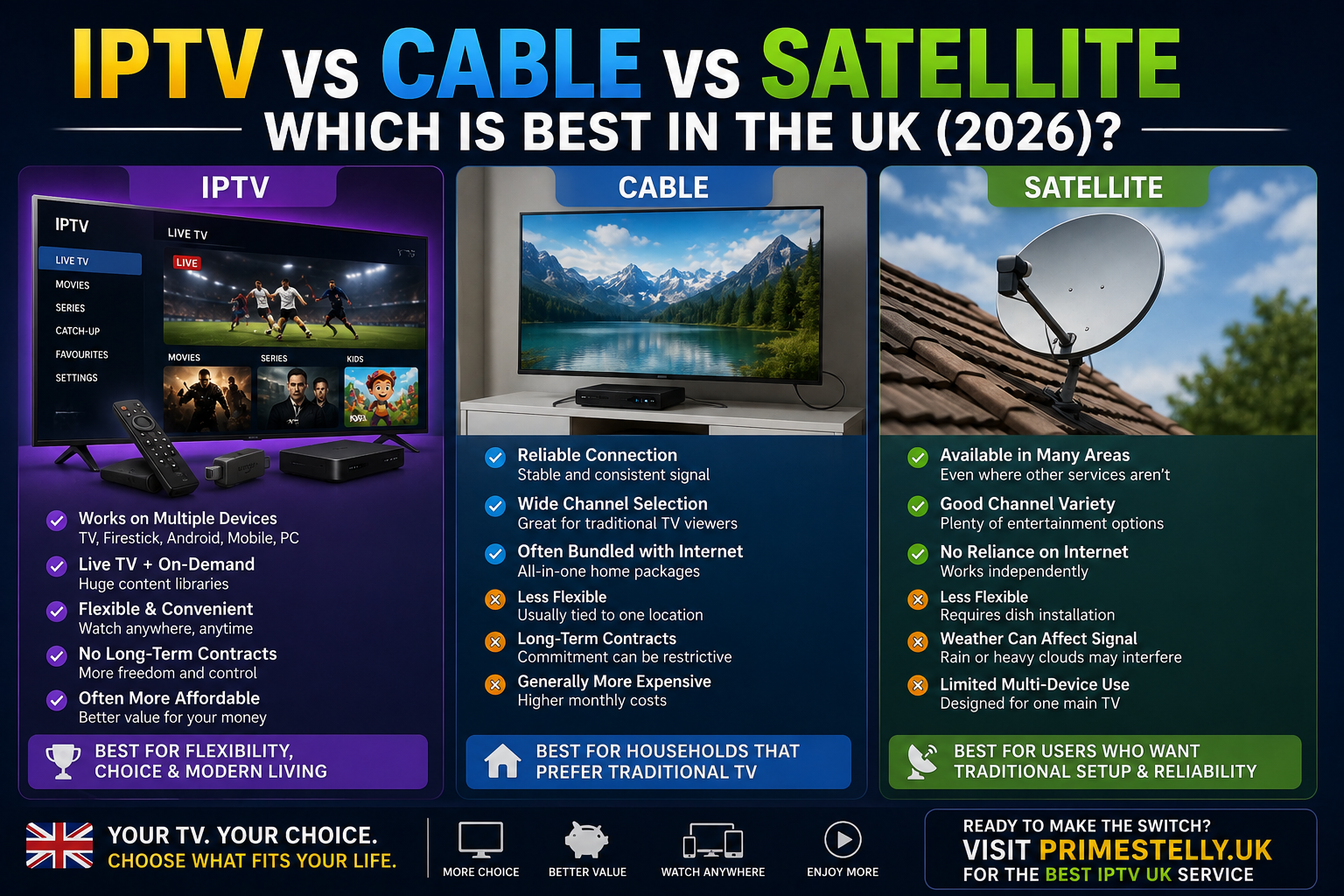
If you are comparing IPTV vs cable vs satellite UK, you are asking the right question. In 2026, UK viewers have more ways to watch television than ever before. Some households still prefer traditional television packages, while others want a more flexible setup that works across Smart TVs, Firestick devices, Android boxes, phones, and tablets. Because of that, the decision is no longer just about channels. It is also about price, convenience, flexibility, device support, and overall viewing experience. For many people, the real issue is simple. Traditional cable and satellite services still feel familiar, yet they can also feel rigid. On the other hand, IPTV often feels more modern because it fits the way people already consume content today. Viewers want live channels, movies, series, app-based access, and easy setup without making the whole process harder than it needs to be. That is exactly why this comparison matters. Instead of following old viewing habits automatically, more people now want to understand which option truly fits their home, budget, and daily routine. If you are already looking for a more flexible setup, you can start with this IPTV UK page. Also, if you want to learn how to install it on your device, read how to set up IPTV on Firestick in the UK and how to install IPTV on Smart TV in the UK. What Is IPTV? Before comparing all three options, it helps to define them clearly. IPTV stands for Internet Protocol Television. In simple language, that means television content delivered through the internet rather than through older broadcast methods. As a result, IPTV usually works through apps, streaming devices, and internet-connected televisions instead of relying on a fixed old-style setup. That does not mean IPTV is complicated. In fact, one of the main reasons it has become more popular is because it can feel easier and more flexible once it is installed properly. Instead of being limited to one type of box or one room, users can often watch on different devices depending on their setup. If you are still new to the topic, you should also read what is IPTV and how does it work in the UK. That article explains the basics in a beginner-friendly way. What Is Cable TV? Cable television is a more traditional type of subscription TV service delivered through fixed infrastructure. For many years, this was one of the most common ways to get a large channel package in the home. It often comes as part of a larger home package that may include internet and other services. The main advantage of cable is familiarity. Many households already understand how it works, and some users prefer a standard package with a clear monthly structure. However, cable can also feel more limited than newer viewing options, especially when it comes to flexibility, device choice, and overall control. What Is Satellite TV? Satellite television is another traditional option. Instead of using internet delivery, it relies on dish-based broadcast transmission. Many households have used satellite for years because it has long been seen as a reliable way to receive a wide selection of channels. Still, satellite can feel more fixed and less flexible in 2026. It is often tied to a more traditional TV environment, while modern viewers increasingly want app-based access, streaming-style navigation, and viewing across multiple screens. Why People Are Switching Their TV Setup The biggest reason people compare IPTV vs cable vs satellite UK today is that viewing habits have changed. Years ago, people mainly watched television in one room on one screen through one provider. Now the situation is different. Many viewers move between the living room TV, bedroom screen, phone, tablet, or streaming device. Therefore, the best TV option is no longer only about who provides the most channels. Today, people care more about: That is why IPTV gets so much attention. It fits naturally into a more connected and app-based home environment. IPTV vs Cable vs Satellite: The Main Difference The simplest way to understand the difference is this: Although that sounds basic, the real difference appears in daily use. IPTV feels more like a modern digital platform. Cable and satellite often feel more like traditional television systems. That difference shapes everything from device choice to setup style to user experience. 1. Flexibility Flexibility is one of the strongest reasons many viewers now prefer IPTV. With IPTV, users often have more freedom in how they watch. They can use Smart TVs, Firestick devices, Android boxes, phones, tablets, and other supported devices depending on the service and player they choose. That makes IPTV a better fit for people who do not want to depend on one fixed screen or one rigid setup. Cable and satellite can still work well for viewers who prefer the old style of television. However, they usually feel less flexible. In many cases, they are built more around a primary television setup rather than a multi-device lifestyle. So if flexibility matters most to you, IPTV usually has the advantage. If you want to build that kind of setup, visit this best IPTV UK page first. 2. Installation and Setup Another important comparison point is setup. Cable and satellite services often feel more traditional from the beginning. Some households like that because it feels familiar. However, it can also mean a more fixed process with a more provider-controlled environment. IPTV is different. It often starts with a streaming device, Smart TV app, or Android-based setup. Once installed correctly, it can be much more convenient. You simply use the app, enter the login details, and start watching. That is why many people now prefer IPTV. It gives them more control. Instead of relying on an older setup model, they can use a television environment that feels closer to the apps and devices they already use every day. If your main goal is easy installation, our Firestick IPTV UK guide and Smart TV IPTV UK guide are the best next steps. 3. Device Compatibility This is one