If you are comparing IPTV vs traditional TV UK options in 2026, you are probably trying to cut costs without losing the channels, films, sports and entertainment your household actually watches. Here at united kingdom iptv, we help UK viewers understand what IPTV offers, where it saves money, and what to check before switching from older TV packages.
For years, traditional TV was the default choice. You chose a package, used a box or dish, paid every month, and accepted the contract. However, viewing habits have changed.
Today, many people want flexible streaming on Smart TVs, Firestick, Android devices, tablets and phones. They also want fewer long contracts, fewer extra fees, and more control over what they pay for.
That is why IPTV has become a serious TV alternative UK viewers are searching for. It can offer live channels, sports, films, series and international content through one internet-based setup.
However, IPTV is not perfect for everyone. The right choice depends on your budget, internet speed, device setup, viewing habits and how much flexibility you want.
In this guide, we will compare IPTV and traditional TV clearly, without hype.
What Does Traditional TV Actually Cost in 2026?
Traditional TV can look affordable at first. The basic package may seem reasonable, especially when a provider advertises a short-term offer.
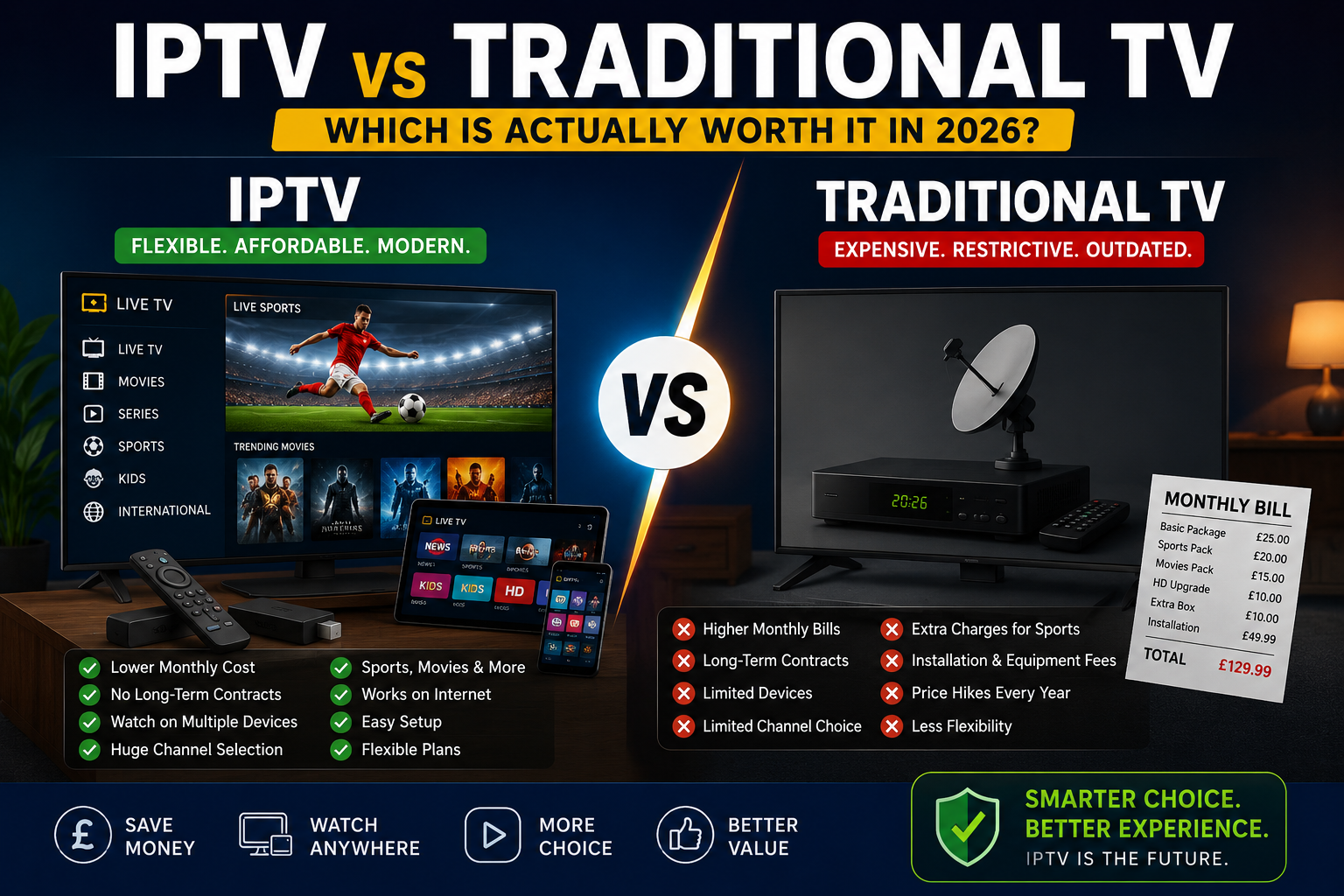
However, the real cost often becomes higher once you add entertainment, films, sports, extra boxes, HD upgrades, installation, and contract increases. This is why many UK households feel their TV bill grows over time.
The main problem is bundling. You may only want a few channels, but you often need a larger package to access them. As a result, you pay for content you barely watch.
Traditional TV also usually comes with more conditions. You may need a fixed contract, specific equipment, and sometimes extra charges if you want to watch in more than one room.
This is where IPTV vs traditional TV UK comparisons become useful. Instead of only looking at the starting price, you need to compare the full monthly cost after add-ons.
Basic Entertainment Package Pricing
A basic entertainment package usually includes general live channels, lifestyle channels, documentaries, news, kids’ content and some on-demand access.
For light viewers, this may be enough. If you mainly watch basic entertainment and do not care much about sports or films, a standard package can still make sense.
However, many households quickly outgrow the basic option. They may want more channels, better picture quality, extra devices, catch-up features, or international content.
That is when the monthly price starts to increase. A package that looks cheap at first can become expensive once you add the features your family actually uses.
With IPTV, the pricing model is usually simpler. Many providers include a wide channel list in one plan, although quality and reliability depend heavily on the provider.
Before you choose, compare what you really watch. Do not pay for a large bundle if your household only uses a small part of it.
Sports Package Pricing
Sports are one of the biggest reasons traditional TV bills become expensive. Many viewers do not just want one sport. They want football, motorsport, cricket, rugby, boxing, tennis and major live events.
Traditional sports packages often cost extra on top of the base TV plan. In some cases, you may also need event-based payments, HD upgrades, or additional channel bundles.
This is why many viewers search for IPTV sports UK options. They want live sports access without stacking several separate charges.
IPTV can be attractive here because a strong provider may offer many sports channels in one place. This can be useful for households that watch different sports every week.
However, sports streaming needs stability. If a service freezes during a match, race or fight night, the lower price does not matter much.
So, when comparing sports options, do not only ask “Which is cheaper?” Ask “Which one stays stable when everyone is watching?” With Primestelly IPTV Canada, viewers can also explore a reliable IPTV option built for smooth sports streaming, flexible device support, and better value without the usual long-term TV restrictions.
Films, Add-Ons and Extra Channels
Films, premium entertainment and extra channel packs are another reason traditional TV bills rise. You may begin with a simple package, then add films, kids’ channels, documentaries, international channels or extra on-demand libraries.
Each add-on can make sense alone. However, together they can turn into a high monthly bill.
This is where IPTV can feel more flexible. Many IPTV packages UK providers include live channels, films, series and international content within one subscription.
That can be helpful if your household watches a bit of everything. One person may want sports, another may want films, while someone else wants international channels or kids’ content.
Still, you should check what is included before paying. Not every IPTV provider has a strong VOD library, and not every service organises content well.
A good provider should make it easy to find films, shows and live channels without endless scrolling.
How Much Does IPTV Cost in the UK?
IPTV usually costs less than traditional TV because it does not rely on the same old setup. Instead of sending channels through a dish or cable box, IPTV streams content through the internet.
This means setup is usually faster. In many cases, you only need a supported device, an IPTV app and your login details.
Most IPTV providers offer different plan lengths. These may include monthly, quarterly, six-month or yearly options. Longer plans often cost less per month, but new users should avoid committing too quickly before testing the service.
A cheap IPTV service is not always the best choice. Very low prices can sometimes mean overloaded servers, poor support, missing channels or unstable streams.
A reliable IPTV provider should offer:
- Clear pricing
- Simple setup instructions
- Good device compatibility
- Support when something goes wrong
- Stable streams during busy hours
- A useful channel list
- VOD or catch-up if included
- No confusing hidden extras
The best value comes from balance. You want a fair price, but you also want a service that works when you actually need it.
If price is your main concern, you can also compare options in this guide: https://primestelly.uk/cheap-iptv-uk/
That page is useful for viewers who want affordable IPTV without choosing a weak or unstable provider.
Side-by-Side Comparison — IPTV vs Traditional TV
When comparing IPTV vs traditional TV UK, the main difference is flexibility. Traditional TV is usually more fixed. IPTV is usually more adaptable.
Here is a clear side-by-side comparison:
| Feature | IPTV | Traditional TV |
|---|---|---|
| Setup | Usually app-based | Usually box, dish, cable or fixed equipment |
| Contract | Often more flexible | Often longer commitments |
| Device support | Smart TV, Firestick, Android, mobile, tablet | Usually tied to approved boxes or apps |
| Channel variety | Can be very broad | Depends on package |
| Sports access | Depends on provider | Usually requires sports add-ons |
| Films and series | Often included with VOD | Often needs add-ons |
| International channels | Usually strong | Often limited or extra |
| Multi-room use | Depends on plan | Often costs more |
| Monthly cost | Usually lower | Usually higher after extras |
| Reliability | Depends on provider and internet | Usually stable but less flexible |
| Support | Depends on IPTV seller | Usually formal support system |
Traditional TV can still be a good choice for people who want a familiar setup, formal support and a predictable viewing experience.
However, IPTV can be better for people who want lower costs, more channels, more device flexibility and less contract pressure.
The important thing is to compare real usage. If you only watch a few basic channels, traditional TV may not feel too expensive. But if you watch sports, films, international channels and on-demand content, IPTV may offer better value.
Channel Selection — What You Get with Each
Channel selection is one of the biggest differences between IPTV and traditional TV.
Traditional TV packages usually divide channels into groups. You may have a base entertainment plan, then separate sports, film, kids, documentary or international add-ons.
This can make things feel organised, but it can also become expensive. If you want channels from several categories, you may need several upgrades.
IPTV often works differently. A provider may include many live channels inside one plan. These can cover entertainment, news, sports, films, kids’ channels, documentaries, and international content. For Canadian viewers who want a flexible IPTV setup, you can visit Primestelly.ca to explore IPTV options for Canada users.
This wider access is one reason people choose IPTV. It can be useful for mixed households where everyone watches something different.
For example, one person may watch live football, another may watch films, someone else may want Arabic, Asian, European or African channels, while children may want family-friendly content.
With traditional TV, that kind of variety can require several add-ons. With IPTV, it may be available in one app, depending on the provider.
However, more channels do not always mean a better service. A huge channel list is only useful if the channels actually work and are organised properly.
Before buying IPTV, ask for:
- Main UK channel categories
- Sports channel coverage
- Film and series options
- International channel categories
- Kids’ and family channels
- TV guide availability
- Backup channels
- VOD availability
If the provider cannot explain what is included, that is a warning sign.
For a wider comparison with older viewing methods, read this existing guide too: https://primestelly.uk/iptv-vs-cable-vs-satellite-uk/
Picture Quality and Reliability Compared
Picture quality depends on more than the service itself. Your internet speed, router, device, app and provider quality all matter.
Traditional TV usually offers consistent picture quality because it uses a controlled system. Once installed properly, it often works reliably without much adjustment.
IPTV depends more on your internet connection. If your broadband is stable, your device is modern, and your provider has strong servers, IPTV can look excellent.
Many IPTV services offer HD and sometimes 4K channels where available. However, quality can vary between providers and channels.
The biggest risk with IPTV is buffering. This usually happens because of weak Wi-Fi, overloaded servers, poor apps, old devices, or peak-time traffic.
To improve IPTV picture quality, you should:
- Use a stable broadband connection
- Choose Ethernet where possible
- Restart your router regularly
- Use a reliable IPTV app
- Avoid old or overloaded devices
- Test streams during peak hours
- Choose a provider with backup channels
Traditional TV may win on consistency. IPTV may win on flexibility and value.
So, the better choice depends on your priorities. If you want the most controlled setup, traditional TV may feel safer. If you want more freedom and lower cost, IPTV may suit you better.
Contract Lock-In — Traditional TV vs IPTV Flexibility
Contracts are a major reason people look for alternatives. Many traditional TV packages involve long commitments, renewal terms or price changes after the first offer ends.
This can feel frustrating. You may sign up for a deal, then later realise the monthly cost increases once the promotional period ends.
IPTV is usually more flexible. Many providers offer short-term plans, which makes it easier to test the service before choosing a longer subscription.
This flexibility is one reason people search for cancel traditional TV for IPTV. They want more control and fewer long-term commitments.
However, you should still be careful. Do not buy a long IPTV plan from a provider you have not tested. Start small, check performance, then decide whether a longer plan makes sense.
A safe buying approach looks like this:
- Check the provider’s website
- Ask what is included
- Confirm device compatibility
- Test the service if available
- Start with a shorter plan
- Check support response time
- Upgrade only when you are happy
Good IPTV should feel simple, not risky. If the provider pressures you to buy a long plan immediately, take that as a warning sign.
Flexibility is one of IPTV’s biggest advantages, but only when you choose carefully.
Hidden Fees and Annual Price Hikes
Traditional TV packages can come with extra costs that are not always obvious at the start. These may include installation fees, equipment charges, HD upgrades, extra-room costs, add-on packages or price increases after the first term.
Even when the starting price looks fair, the final monthly bill may be higher than expected.
This is one reason many UK viewers compare IPTV vs traditional TV UK before renewing. They want to understand the full cost, not just the advertised headline price.
IPTV can be more direct. Many providers offer one price for one plan length. However, that does not mean every IPTV service is transparent.
You still need to watch for red flags, such as:
- Unclear pricing
- No refund policy
- No support contact
- No setup instructions
- No device guidance
- Unrealistic promises
- Pressure to buy a long plan
- No information about plan limits
The best IPTV services are clear about pricing, setup, device support and what happens after payment.
If a provider is vague before you pay, support will probably be worse after you pay.
Transparency matters. Whether you choose IPTV or traditional TV, you should know exactly what you are paying for.
Which One Is Right for Your Household?
The right choice depends on how your household watches TV.
Traditional TV may suit you if you want a familiar setup, do not mind contracts, and prefer a controlled system with formal support.
IPTV may suit you if you want more flexibility, lower monthly costs, wider channel access and app-based streaming across different devices.
For many UK households, IPTV feels more practical because viewing habits have changed. People no longer watch everything through one box in one room.
A modern household may use:
- A Smart TV in the living room
- A Firestick in the bedroom
- A tablet in the kitchen
- A phone while travelling
- An Android box for extra flexibility
IPTV fits this style better because it is built around apps and internet-connected devices.
However, your internet connection needs to be good. If your broadband is unstable, IPTV may not perform well. In that case, improving your router or using a wired connection can make a big difference.
You should also think about content. If your family watches sports, films, international channels and live TV, IPTV may offer better value.
If you only watch a small number of basic channels, you may not need a large IPTV plan or a traditional premium package.
The smartest approach is to compare honestly. Look at your current bill, list what you actually watch, then decide whether IPTV gives you better value.
For many people, IPTV is not just cheaper. It is more convenient.
That is why IPTV vs traditional TV UK has become such an important comparison in 2026.
FAQ
What is the difference between IPTV and traditional TV?
IPTV streams live channels and on-demand content through the internet. Traditional TV usually relies on a dish, cable line, box or fixed provider equipment. IPTV is usually more flexible, while traditional TV is often more controlled.
Is IPTV cheaper than traditional TV in the UK?
IPTV is often cheaper because many services include live channels, sports, films and international content in one plan. Traditional TV can become expensive when you add sports, films, extra rooms and other upgrades.
Is IPTV a good TV alternative UK viewers can use?
Yes, IPTV can be a good TV alternative UK viewers can use if they have stable internet and choose a reliable provider. It works best for people who want flexibility, more channels and lower monthly costs.
Can I cancel traditional TV for IPTV?
You can cancel traditional TV for IPTV if IPTV gives you the channels, sports and content your household needs. Before cancelling anything, test IPTV first and make sure it works well on your device and internet connection.
What devices can I use for IPTV in the UK?
You can use IPTV on Smart TVs, Firestick, Android TV boxes, Android phones, iPhones, tablets, laptops and some streaming devices. Device support depends on the IPTV app and provider.
Does IPTV need fast internet?
Yes, IPTV needs a stable internet connection. HD streams usually need reliable broadband, while 4K streams need stronger speed and better stability. Ethernet is better than Wi-Fi where possible.
Does IPTV have live sports?
Many IPTV services include live sports channels, but coverage depends on the provider. If sport is important to you, check the channel list and test the service during live events before choosing a longer plan.
Are IPTV packages UK services easy to set up?
Most IPTV packages UK services are easy to set up if the provider gives clear instructions. Usually, you install an IPTV app, enter your login details, then load the channels.
What should I check before buying IPTV?
Check pricing, channel list, device support, support response time, setup instructions, stream stability, plan length and refund terms. Avoid providers that give vague answers or push long subscriptions too quickly.
Which is better: IPTV or traditional TV?
IPTV is better for flexibility, price and wider device support. Traditional TV may be better for viewers who prefer a fixed setup and formal support. The best choice depends on your budget, internet and viewing habits.